


Commerce is changing at its core In fact, there's a fundamental shift in the very nature of what a product is. Products are in the process of transforming from artifacts to experiences. Golf clubs are no longer weighted sticks with which to hit a ball; they have embedded chips that integrate with software to help you analyze and adjust your swing. The club has gone from tool … [Read more...]
Duolingo: Esta Aplicación Es Muy Buena

It has long been my ambition to learn foreign languages, but to do so using the wrong accent. For instance, I've always wanted to learn Spanish with an Australian accent: Along comes Duolingo to help make my dreams come true. Duolingo promises free language education for the world and has some really great tactics for delivering on that promise. It's … [Read more...]
Universe… You Got A Lotta Splainin’ To Do.

I recently read an interesting article over on NPR's site, called Why We Need A Science Capable Of Explaining Itself. It was an interesting read in which the author, Marcelo Gleiser, makes the assertion that big science (cosmology) and religion can exist side-by-side as long as science admits that it can't explain everything. However, I would argue that the author makes the … [Read more...]
Adaptive Reading » Example

Based on my last post, I thought I'd provide an example of what I meant. Here's a short piece of writing that can adapt to a specified level. None of the levels are accurate, just an example of what I mean: Let me know what you think. … [Read more...]
A Rosaceae Rosa By Any Other Name…
I have an interesting conundrum and an interesting proposition for a solution. I'd be interested in input from the two of you who actually read my blog... The Problem My daughter (henceforth referred to as "The Bean") was an early reader. She read early and often. As a result, she now reads at a level well beyond her school years. To be precise, she reads at a 9th grade … [Read more...]
Weekly Wordle: Declaration of Independence
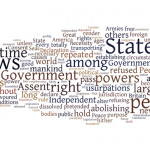
Given that the 4th of July is approaching, I thought it would be good to see the concepts that bubble up from that foundational document of our freedom. Rendering of the Declaration of Independence on wordle.net … [Read more...]
Google Glass = Half Full?

Google has received a bit of press for it's announcement that its product, Glass, will be manufactured in the US (at least early runs). Google held a competition called #IfIHadGlass to identify eager early adopters. Winners will get the "chance" to pay $1,500 to get their hands on the product before the general public does. There are several reasons Google probably wants to … [Read more...]
Big Data: Does Size Really Matter?

"Big Data" is one of those terms that gets thrown around my workplace with reckless abandon these days. So much so, that it begins to lose it's flavor. What does Big Data really mean? Certainly, we've seen a lot of lip-service paid to the sheer volume of information being generated on a daily basis (the Taming The Torrent video is a couple years old, but captures the gist of … [Read more...]
The Internet Of You

I just read an intriguing article (I used Google Glass: the future, but with monthly updates) that discussed the benefits and drawbacks of the Google Glass project in its current state. I, for one, am ready to be a cyborg. The promise of Google Glass is that it will give us a heads-up display at every moment of our life. While scanning your environment for clues, Glass provides … [Read more...]
Shrodinger’s Cat And Strategy

My wife and I are coming to terms with the fact that we are staring down the barrel of the end of a two year tour of duty for work that has taken us from Chicago to Southern California. We don't have to go back, but there are compelling reasons for us to do so (finances, friends, family, educational system, etc.). We don't have to stay, but there are compelling reasons to do so … [Read more...]
- « Previous Page
- 1
- 2
- 3
- 4
- …
- 6
- Next Page »